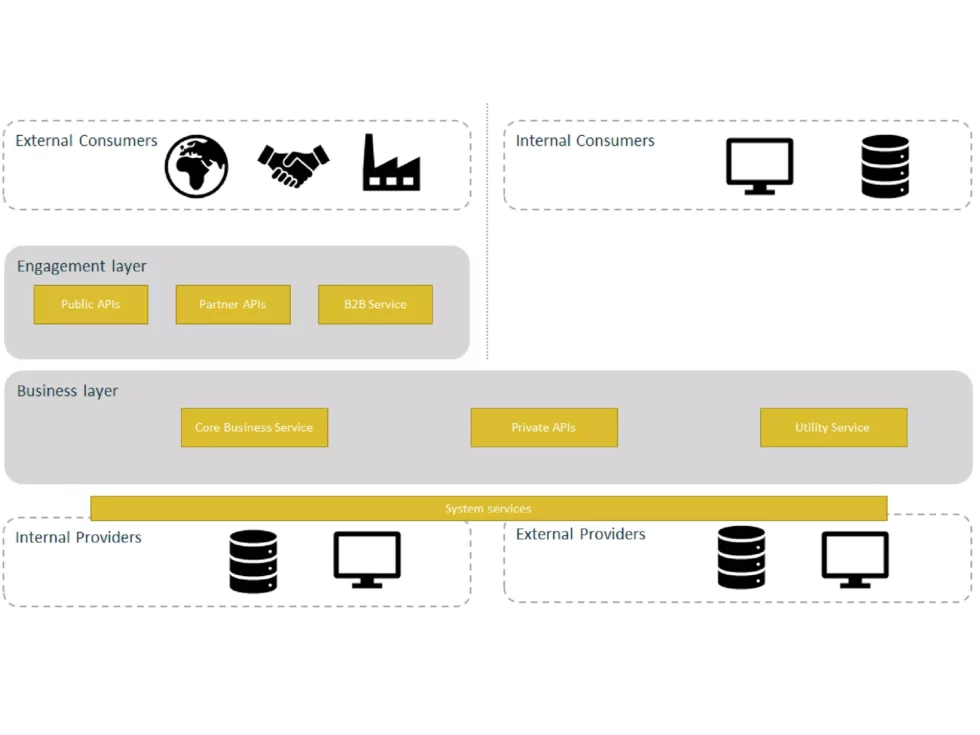

Many organizations have been looking at SOA (Service-Oriented Architecture) in the past to tackle and govern their integration challenges. One of the key aspects within a SOA landscape is the layering and classification of services. At Achers, we have seen many organizations each having their own way to classify their services. Some of them are based on the service layers defined by Thomas Erl, others are based upon a more technical approach like the service categorization defined by Oracle (Process, Activity, Data, Utility services).
The same questions show up at companies implementing an API program. They face the same challenges when it comes to API layering and classification, taking into account an already existing service classification.
In this blog post we will explain why API and service classification is needed and how this classification can be done.
But First…
… let’s take a look at the differences between a service and an API.
- A service exposes data and functionality to the rest of an organizations’ IT landscape, serving specific business needs.
- An API, within the context of API management, can be seen as a product the organization exposes towards its ecosystem of consumers that might be interested in using that APIs’ data and functionalities. Unlike services, APIs are typically made available to a developer community by an API developer portal.


![[RECAP] API Community Belgium – The API Management Journey of Fednot](https://we-archers.com/app/uploads/2025/10/RECAP-API-Community-Belgium-–-The-API-Management-Journey-of-Fednot-1024x342.webp)
